In Parliament on Tuesday (April 7), Minister for Foreign Affairs Vivian Balakrishnan set out why Singapore's position is to not negotiate on tolls or for safe passage through the Strait of Hormuz.
He cited the United Nations Convention on the Law of the Sea (UNCLOS), highlighting that the right of transit passage is not a privilege to be granted by any bordering state of an international strait.
"It is not a licence to be supplicated for, it is not a toll to be paid. It is a right of ships to traverse," Dr Balakrishnan explained.
Videos of Dr Balakrishnan's statement have been widely watched, receiving over 1.3 million views on AsiaOne's TikTok channel, and over 600,000 and 900,000 views on CNA's and The Straits Times' respective channels.
@asiaone
In Parliament on Tuesday (April 7), Foreign Affairs Minister Dr Vivian Balakrishnan explained why it is important for Singapore to uphold the principle of right of transit passage, and not engage in negotiations on toll payment or safe passage for ships transiting through the Strait of Hormuz. #sgnews #Singapore #Parliament #MiddleEast #War #Shipping #Maritime
♬ original sound - AsiaOne
On Thursday, UAE Minister of Industry and Advanced Technology Sultan Al Jaber published a similar opinion in a LinkedIn post.
He said that the Strait of Hormuz was not built, engineered, financed or constructed by any state. Instead, it is a natural passage governed by UNCLOS, which guarantees transit as a matter of right; not a privilege to be granted, withheld or weaponised.
"Conditional passage is not passage. It is control by another name. The Strait must open — fully, unconditionally and without restriction," the minister said.
Dr Sultan, who is also managing director and group chief executive officer at the Abu Dhabi National Oil Company, went on to state that if conditional passage is allowed, it would set a dangerous precedent for the world, which could undermine the principle of freedom of navigation that underpins global trade and, ultimately, the stability of the global economy.
'No shipping, no shopping'
AsiaOne spoke with international relations and maritime experts to understand the importance of maritime law and protecting national interests through diplomacy.
Nicholas Lim, senior fellow at the S. Rajaratnam School of International Studies (RSIS), used an old shipping tagline: "No shipping, no shopping."
"Since the start of the conflict, economies of the world have been affected because ships carry oil, goods, containers... if international straits are closed or subjected to conditions, ships will not be able to transport these items. The impact will go beyond just shopping to affect the livelihoods of many in the world," he said.
Lim, who specialises in the maritime and security domain, also pointed out that neither UNCLOS nor the San Remo Manual on International Law Applicable to Armed Conflicts at Sea provides any legal basis for the imposition of tolls.
Iran has asserted control over the vital artery, a conduit for a fifth of the world's oil and liquefied natural gas supply, and reportedly demanded tolls for safe passage.
With the gap in global energy flows now past the 40-day mark, Dr Sultan expects that the impact will go beyond the energy sector to affect economies, industries and households worldwide.
He said there are an estimated 230 vessels loaded and waiting to sail. "[Global] stability now depends on restoring real flows, not partial access, not temporary measures, not controlled passage, but full and reliable supply."
Why Singapore chooses alignment with international law
Professor Joseph Liow, dean at the Lee Kuan Yew School of Public Policy, told AsiaOne in an interview that more than ever, being aligned with international law — as a principle — matters amid a VUCA (volatile, uncertain, complex and ambiguous) environment.
Referring to the rapidly changing situation in the Middle East, with US President Donald Trump threatening Iran's annihilation only to agree to a ceasefire on the same day (April 7), Prof Liow suggested that countries will need to be clear about their national interests and principles as a basis to anchor around the uncertainties.
"The fragile two-week ceasefire is already showing signs of strains. It's a fluid situation, and because of that, Singapore must be very clear on what our national interests and principles are, even as it adjusts its strategies."
Likening principles to "north stars", Prof Liow went on to explain: "Singapore is basically aligning itself with international law.
"Even if other countries are also aligned with international law, and we have similar positions, it does not mean that we are aligning with them. We are all aligning with international law."
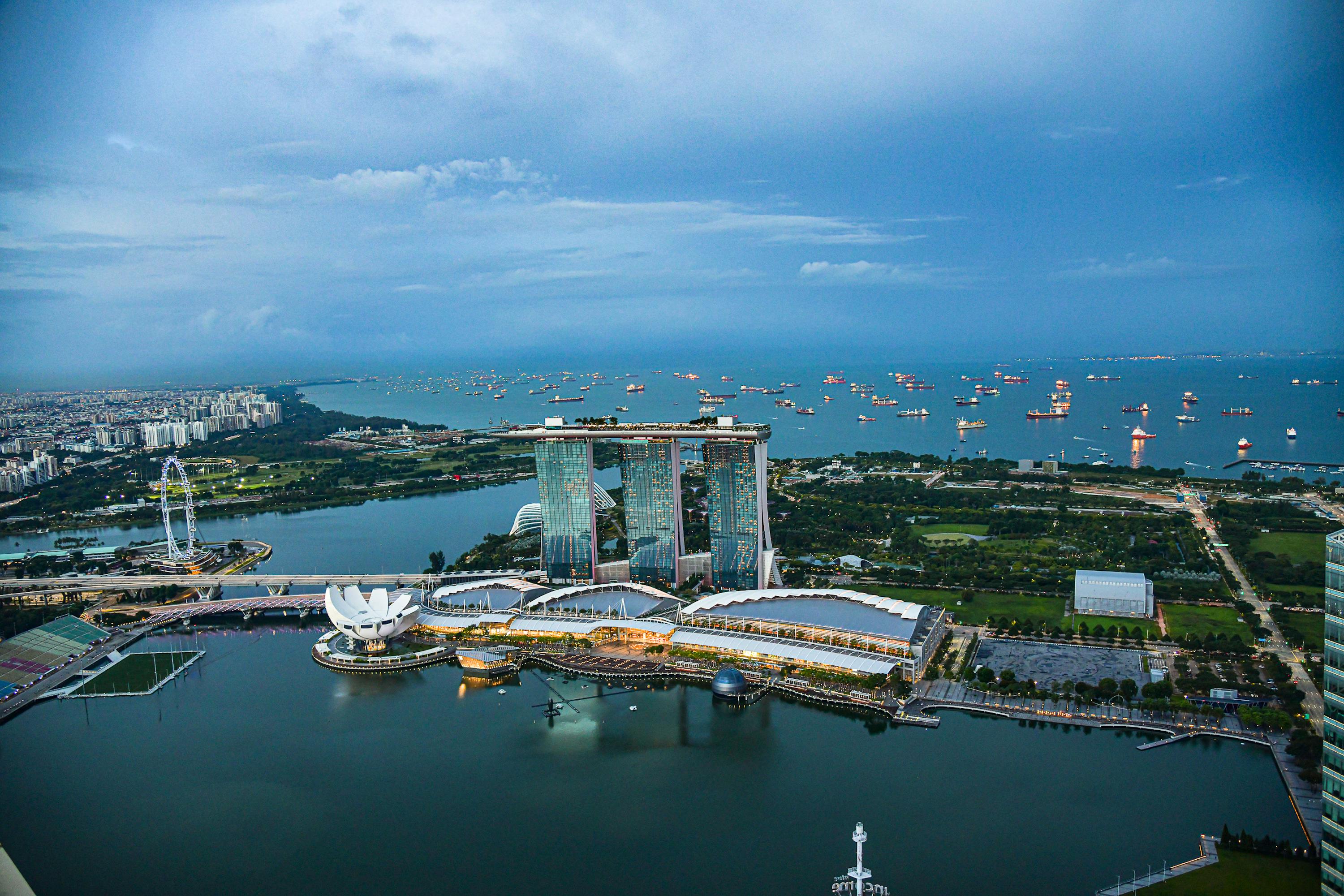
Contextualising this, Lim explained that as a maritime nation and global hub, sea trade contributes about 7 per cent to Singapore's gross domestic product.
"Almost everything that we consume comes through our waters. For a small country like Singapore, our success and, in fact, our livelihood has been contingent on a rules-based order. International law is thus not an academic exercise; it is our lifeline. If rules are broken because 'might is right', Singapore will not be where we are today," he said.
Asked about Singapore's position in choosing not to negotiate on matters enshrined in international law, Prof Liow pointed out that Dr Balakrishnan did not say there will be no engagements.
"He (Dr Balakrishnan) said he will engage his Iranian counterpart 'in the near future', just not in negotiations for safe passage of ships, or on toll rates — because of Singapore's alignment with international law."
Turning to the example of Malaysia-bound crude oil tanker Ocean Thunder, Prof Liow pointed out that the Malaysian government said the "positive outcome" was a result of high-level diplomatic engagements.
"The point is that you have those channels — engagements, negotiations — of communications open. You try to use those channels to ensure that your national interests are met."
He added: "Sovereign countries have to do what is best for their countries in order to achieve their objectives. Whether it is through negotiations or engagements, that is not the point. The point is about achieving objectives."
On Friday (April 10), Malaysia Prime Minister Anwar Ibrahim, responding to media queries about Singapore's position, said the city state's view "is their affair", adding that Malaysia's approach is based on its independent foreign policy stance.
But the Malaysian prime minister also highlighted that while Malaysia cannot discuss Iran's response without also speaking about the actions of Israel, supported by the United States, it must also maintain its friendships with neighbouring countries.
[[nid:733417]]
[email protected]
No part of this story can be reproduced without the permission of AsiaOne.




