

'Welcome home': What war taught me about Singapore

The author and his family before boarding the first RSAF repatriation flight from the Middle East on Tuesday (March 10) evening.
PHOTO: Nisar Keshvani

"Welcome home."
Those two words carried a weight I had never felt before.
They were spoken by a Republic of Singapore Air Force (RSAF) serviceman as my family boarded the evacuation aircraft in Riyadh that would take us safely back to Singapore.
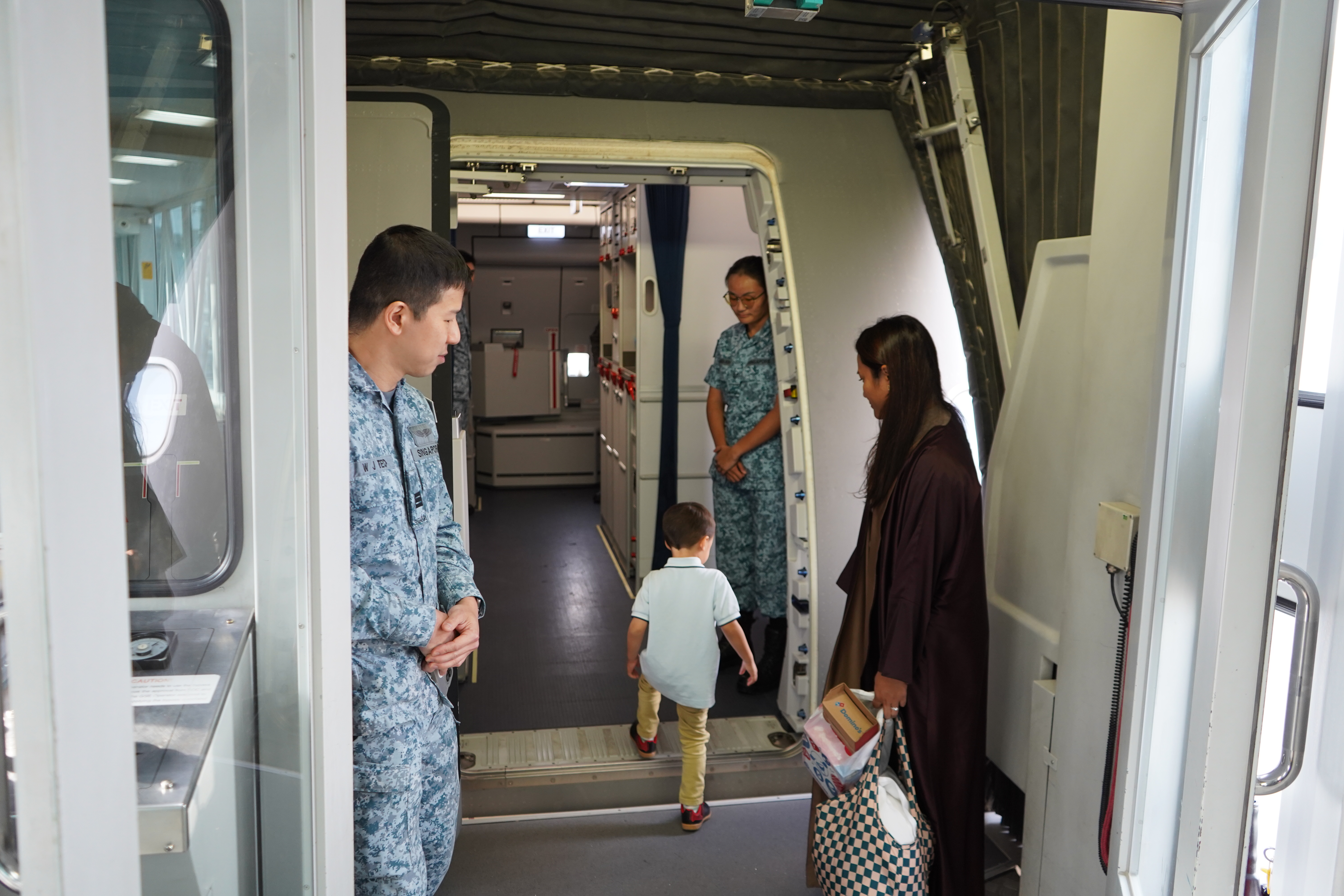
We had not even taken off yet. But in that moment, something shifted inside the cabin.
Passengers looked around quietly. Some smiled. Others wiped away tears.

When the captain finally announced we were cleared for departure, a collective sigh of relief passed through the aircraft. As the plane lifted off the runway, applause broke out.
Then voices slowly rose across the cabin.
Someone began singing Majulah Singapura.
Others joined in.
It was one of those moments when you realise that home is not simply a place on a map. It is something deeper - a shared identity, a sense of belonging, and the knowledge that when things go wrong, your country will come for you.
Just weeks earlier, life had been normal.
My family and I had been living in Doha, where I work at Northwestern University in Qatar. Like many Singaporeans working abroad, we had built a temporary home there while continuing to stay closely connected to Singapore.
Then the missile attacks began.

Over the following days, more than one hundred missiles were launched toward Qatar during escalating tensions across the Gulf region. Thankfully, they were intercepted by the country's defence systems.
But living through it was something else entirely.
For my family, the safest place in our home became a small corner on the ground floor - about two metres by two metres - reinforced by pillars, without windows.
The sirens were the hardest part.
Each one jolted the senses. Our children - Sahil, 12, and Maayah, 10 - struggled to understand why missiles were flying overhead.
At night, when interceptions shook the house, they clung tightly to us. As parents we tried to remain calm, even as our own hearts raced.
[[nid:731230]]
At the same time, my colleagues and I were working around the clock managing crisis communications for the university community - verifying information, coordinating with partners, and ensuring faculty, staff and students remained informed without causing unnecessary alarm.
The professional demands were intense.
But the emotional strain on families was even greater.
Throughout that period, my wife Malathi became the steady anchor of our household. While I spent long hours responding to the unfolding crisis at work, she focused on keeping the children calm and maintaining a sense of normalcy at home.
Leadership during crises often happens quietly - inside homes, away from the spotlight.
Eventually, the Singapore Embassy contacted us and advised Singaporeans in the area to prepare to leave.
Getting out was not straightforward.
Airspace closures meant commercial routes were uncertain. Our initial evacuation plan involved travelling by bus from Doha to Riyadh before attempting multiple connecting flights through other countries.

Then Singapore made the decision to deploy an RSAF aircraft.
That decision changed everything.
For many Singaporeans, the presence of our military is something we associate with National Day parades, overseas training exercises, or humanitarian missions reported briefly in the news.
But in that moment, standing at the foot of the aircraft stairs in Riyadh, we saw something deeper.
Our soldiers had flown thousands of kilometres into a volatile region to bring fellow Singaporeans home.
They served meals, checked on passengers, reassured worried families, and spoke to each person with calm professionalism.
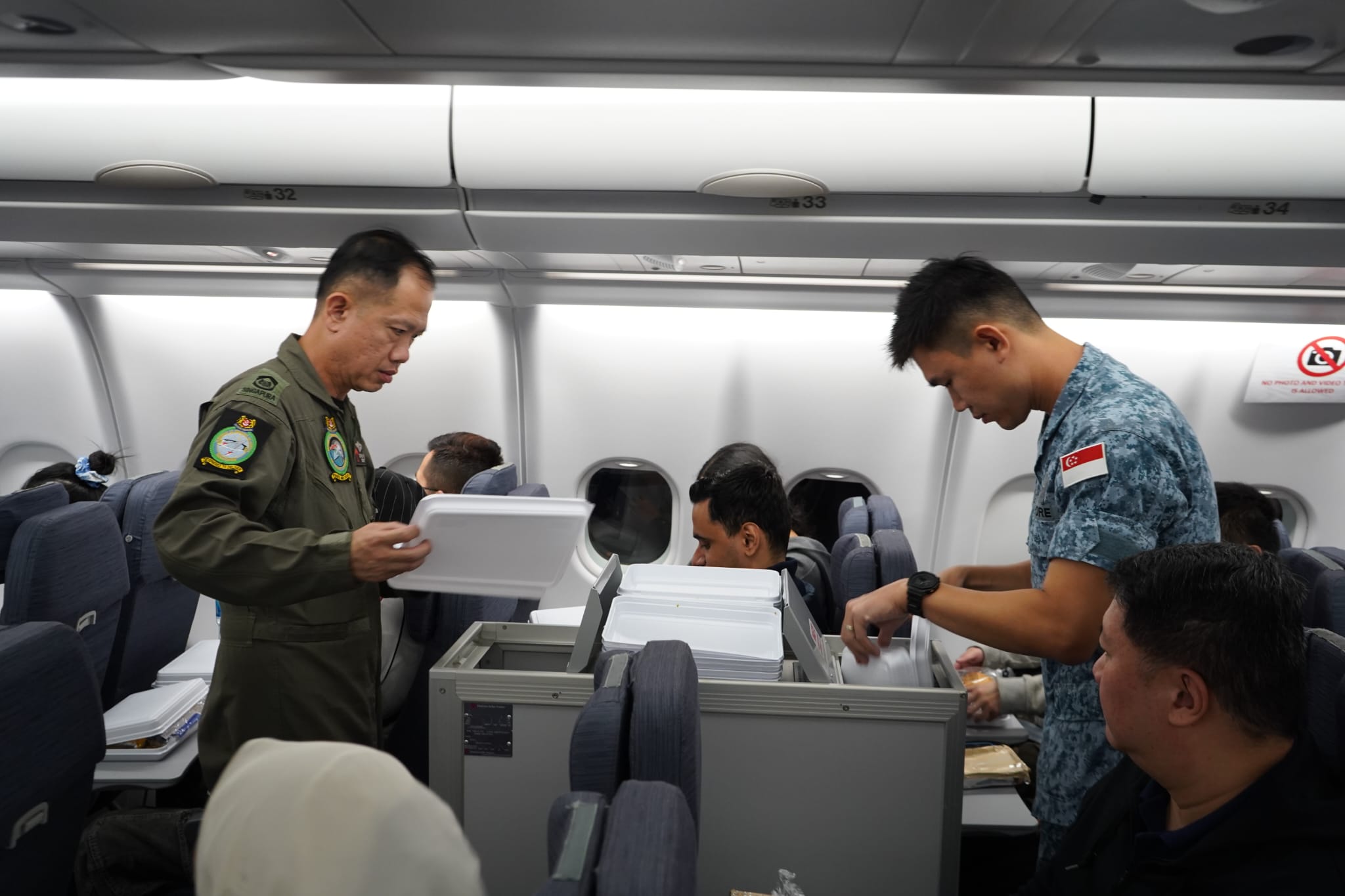
It is a side of service that is rarely visible.
Our soldiers do not only defend Singapore's borders.
Sometimes, they go into uncertain situations abroad so that fellow citizens can return home safely.
Malathi captured the moment best.
"The way they spoke to us - the Singapore way of making you feel," she later said. "When you hear them say 'Welcome home', you already feel like you are home."
She admitted she still felt a small moment of fear, knowing the aircraft would be flying through uncertain airspace.
"But when the pilot came on and said it was an honour to bring us home," she said, "that was the moment I felt we were safe."
Our extended family in Singapore had been checking in constantly, offering reassurance across thousands of kilometres.
That support - from both family and country - meant more than words can describe.
When the aircraft finally lifted off and passengers began singing the national anthem, the emotion inside the cabin was overwhelming.
In that moment, the meaning of citizenship became very real.

For Singaporeans who have grown up in a peaceful and stable society, it is easy to assume that peace is the natural state of the world.
But living through a conflict zone, even briefly, changes that perspective.
Peace is not automatic.
It exists because of careful diplomacy, disciplined institutions, and the quiet dedication of people who work constantly to preserve stability.
Singapore's response to the situation reflected something fundamental about our national character.
It was calm. Methodical. Thorough.
Every possible commercial option had been explored before the RSAF aircraft was deployed. When it was, the operation was conducted with the precision and professionalism Singapore is known for.
For those of us on that plane, it was a powerful reminder that the Singapore system - built patiently over generations - continues to function even when circumstances become unpredictable.
If there is one lesson I take from this experience, it is that the stories behind peace should not be forgotten.
Many of our parents and grandparents lived through turbulent times. Yet they often spoke little about those experiences.
Perhaps they hoped their children would never have to face the same hardships.

But those stories carry important lessons.
They remind us why stability matters. Why resilience matters. Why service matters.
And they remind us that peace must never be taken for granted.
As the RSAF aircraft carried us home that night, the words "Welcome home" meant something entirely new.
They were not just a greeting.
They were a promise.
That wherever Singaporeans may be in the world, our nation will look after its own.
And that is a promise worth protecting - generation after generation.
@asiaone “Welcome home” hits differently when you hear it from your country's air force. #sgnews#MiddleEast #War #Iran #SaudiArabia #Singapore #AirForce #Homecoming ♬ original sound - AsiaOne
The author and his family were on board the first RSAF repatriation flight from the Middle East which landed at Changi Airport on Wednesday (March 11) morning. Permission required for reproduction.
[[nid:731389]]